Scan. Validate. Print.
Every O3D orthosis starts from a patient 3D scan — not a template. The result: a device that matches the anatomy to the millimetre, from the very first fitting.
The process, in three steps
From scan to delivered device, a fully digital process.
Scan
The clinician captures the patient's anatomy in minutes with Cleo, our 3D scanning app on iPhone, iPad and Android. Foot, hand, knee or lower limb: the app itself selects the right capture experience. No casting, no molding, no waiting.
Validate
Our design algorithms generate the orthosis from the scan — tension and comfort zones managed to the millimetre — and the clinician previews the device before production. What is delivered is exactly what was validated: no surprises at delivery. And each device's file is kept indefinitely — remaking an identical one requires no new measurements.
The orthosis is made by industrial 3D printing, a technology that creates long polymer chains. In concrete terms: the most resistant printed frame on the market, in an ultralight, ventilated device. The printers work day and night — lead times no longer depend on a cast drying.
Cleo — the 3D scanning app
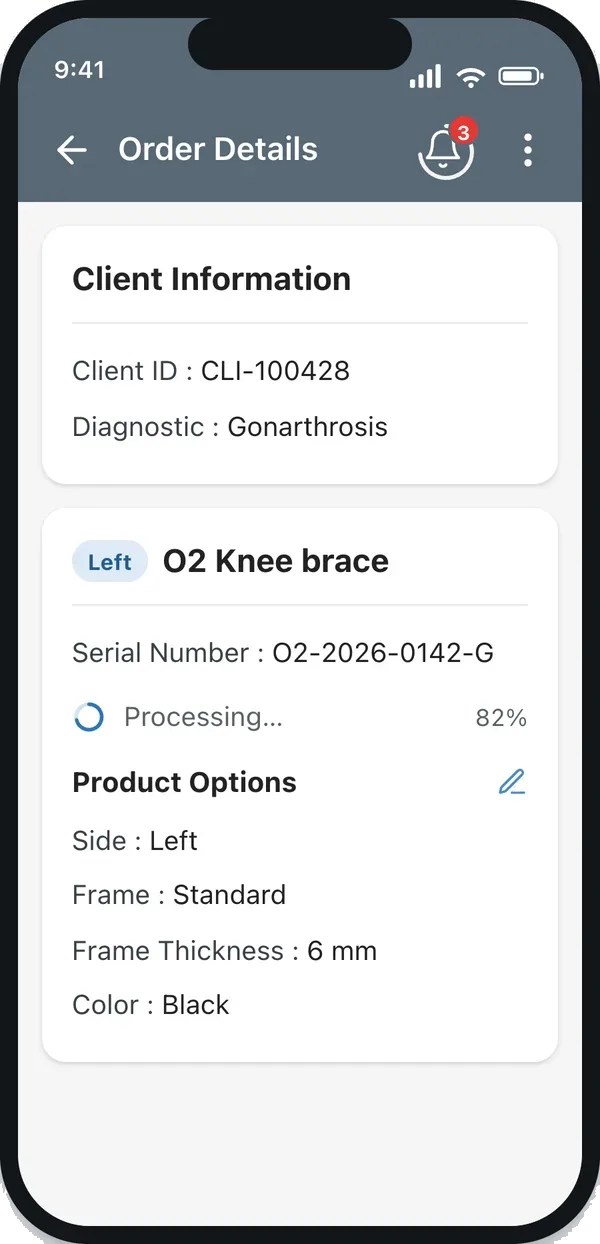
The clinician's everyday tool: Cleo captures the patient's morphology in minutes, on iPhone, iPad and Android, with order-taking built right in — no extra hardware needed, just the phone. Reserved for clinicians — become a partner to activate it.


Apple and the App Store logo are trademarks of Apple Inc. Google Play and the Google Play logo are trademarks of Google LLC.
What sets an O3D orthosis apart
Four principles applied to every device, without compromise.
100% custom-made, industrial quality
No pre-made template: the need defines the orthosis. Manufacturing precision to the millimetre — down to 100% identical pairs.
Stress-tested
Every design is proven; latest-generation materials combine rigidity and lightness.
Patient-adjustable
The integrated BOA® system, recognized worldwide for its reliability, allows precise, fast tightening every day.
100% Made in Canada
From acquisition software to printing, including design: every step is carried out here.
Cleaner manufacturing
On the O2 knee brace, 3D printing produces 23 times less waste than the traditional molding method, and 80% of the unused powder is recycled into the next production run. Custom-made, without the waste.
Proof through results
On the O2 knee brace, digital design enables multi-vector correction: we correct the joint angle, but also the femoral translation. Clinical tests (WOMAC, after 6 to 8 weeks of use) show a 20-point improvement.
Are you an orthotist?
Offer your patients perfectly adapted devices, without changing your practice. Scan, validate, deliver — we take care of the rest.